Showing posts with label high standards. Show all posts

Thursday, February 13, 2014

Chocolate is back


What would you do to create the perfect product?  How about take 5 flights, canoe for 5 hours through the Amazon, and then trek 15 kilometers through the Bolivian jungle?  That is what it takes just to get the raw cacao for Oialla chocolate.  And we haven’t even started to discuss production yet.  And Rasmus Bo Bojesen, the owner of Oialla and chocolatier, will not settle for less.

This all started a few years ago when Rasmus’ wife asked him one morning why
they didn’t make organic chocolate.  This question didn’t come out of the blue.  Rasmus is a world-renowned chef and restaurateur who owns Axelborg and The Royal Danish Opera Restaurant.  (He has started several other restaurants throughout Denmark.)  His obsession with chocolate started over thirty years ago while working as a chef at Michelin star restaurants and as an apprentice to Lyon master-chocolatier Bernachon. Since then he has studied chocolate.  When I write studied, I mean that the man should have a doctorate in cacao if there were such a thing.  In addition to making and selling chocolate and delicacies in his restaurants and shops over the years, he started Bojesen Chocolate, which produced raw chocolate, in 2006.  And then he wrote a cookbook, “A Sense for Chocolate” that was published in 2009 (for which he won the Gourmand Best Chocolate Book in the World Award in 2012).  When he talks about chocolate, he beams as though nothing else in the world matters. 

So when his wife asked about making organic chocolate, Rasmus’ response was “Three reasons. Taste. Taste. And Taste.”  At that time organic cacao beans had a reputation for poor quality.  The supply of organic cacao was extremely limited and not consistent. But the couple was up for the challenge.  They talked with friends and colleagues, including an agriculture professor nearby that suggested that the cacao they were searching for may exist in the wild and only in the jungles of Bolivia.  After a lot of research, a small protected area was located that had virtually untouched cacao trees around Baures in the Beni region of Bolivia.  And they weren’t exporting the beans. 


This is where the 5 flights, 5 hours canoeing, and 15 km hike come in.  There was no assurance that Bolivia would have the quality of beans that Rasmus demanded.  In fact, he didn’t have proof that this raw material even existed. First, Rasmus met with locals who worked with Bolivian wild cacao harvesters. He then went to the sites to taste the beans and meet the workers.  He was surprised by what he found, an impressive bean with no acidity and bitterness that is usually associated with raw cacao.  He had found his bean.  And it doesn’t get more organic.  These trees have not been cultivated, fertilized, or treated with herbicides. The pods that are produced are about half the size of traditional pods, but hold much better flavor.  These are among the few beans that I have tasted that are not bitter.  They have a solid cacao flavor without the harsh aftertaste. 


Social entrepreneurship


When asked about gaining the trust of the Bolivian farmer, Rasmus shook his head.  “There are no farmers.  There are no farms.  This is the jungle.”  Trust was a big deal.  After working with the beans, he found that the fermenting and roasting process needed a small change.  However, this change flew in the face of what had been done by the locals for generations.  Thus, the relationship with the workers was critical to success. Additionally, the chocolate industry is notorious for the obscene use of child and slave labor. Since the location was deep in the jungle, it would have been easy for a company to come in and exploit those who live there.  Oialla now works with the Danish Foreign Ministry to set and ensure high standards for working conditions. 

Innovation

Working with these beans has not been easy. As I mentioned earlier, the pods are smaller and the beans have a different flavor than traditional beans.  This cacao also has more cocoa butter.  Thus, the traditional ways of making chocolate did not work.  New recipes needed to be perfected before products were ready.  Initial products were launched in 2010 and in less than a year, Oialla won an award from the “Academy of Chocolate.”  Later in 2011, they won the Gold in Great Taste Awards.  In 2012, Rasmus was invited to a small conference with the most talented chocolate makers in the world.  Although impressed with Oialla, a colleague asked why he didn’t get the entire flavor from the bean.  Puzzled, Rasmus went back to the kitchen and spent almost a year refining the manufacturing process.  He says that he now understands what his colleague meant.  The 78% chocolate now has a fuller flavor that captures more of the nuances of the Beniano beans. 

The product

When I visited Oialla, I was offered a beautiful tray of chocolate to taste, first the solid wafers and then the truffles and nuts.  Bottom line - Oialla chocolate is so good that I actually felt guilty eating it.  There were so many wonderful choices.  Now, I wish that I had taken the whole plate, thrown it in my bag and ran out with the treasures.  I knew that you could buy the chocolate wafers, but now I find out that the truffles and other chocolates are not sold.  Cruel cruel world.


At first, Oialla was produced as 72% and 78% dark chocolates (percent of cacao solids).  They just started producing a 46% milk chocolate.  Although chocolate snobs often look down at the lighter versions of chocolate, this milk is for the connoisseur. Rasmus made a subtle, but genius change to the manufacturing process that takes this milk chocolate to another level. I can’t tell you the secret, but it is brilliant.    
  

Recipe for success: Passion

What does every entrepreneur need? Passion. Everywhere you turn, people who are talking about successful entrepreneurs talk about passion.  But, what is passion?  The dictionary uses synonyms such as intense, driving, overwhelming conviction, strong desire, and enthusiasm. 

Passion is what gets you through the unforeseen difficulties and challenges, and there always are some.  In talking with Rasmus, you can’t help but understand his need to make the best product that he can, whether it be gourmet meals or organic chocolate.  He is also witty and down to earth, breaking out the beautiful photo book that his wife produced after their last trip to Bolivia with their children. It is a terrific combination that has served him well.  We may very well find Rasmus’ photo under passion in the dictionary.


Sunday, September 8, 2013

From Technology to Tea

Onomea Tea

Rob Nunally and Mike Longo started Onomea Tea Company in 2003.  This was a second, if not third career for both of them.  Rob and Mike started Onomea Tea after realizing that their initial crop of choice, daylilies, would not grow as consistently as needed for cultivation.   Considering their options while drinking tea, they thought – “Why not grow tea?”  Having green thumbs and plenty of available property on Hawaii’s Big Island, they jumped in.  A new career was born.

Before Onomea, Rob lived in California.  He attended CA State University and received a BA in Business with an emphasis in Information System. This was perfect for Silicon Valley and he started in with a software support job and ultimately his own technology business. Since most of the technology was sold internationally, this business could be run from most anywhere.  In 2010 the political climate for the business changed and the business income dropped substantially, since that time he has been more focused on tea.

Mike was born and raised on the East Coast.  He grew up working in his father’s nursery and garden business and studied Biology and Chemistry at Marquette University.  After teaching high school biology, Mike’s path led him to the National College of Chiropractic and a career as a Chiropractic Physician and Natural Health Practitioner.  Mike lived in Fiji for a short time and eventually moved to Hawaii Island in 1977. He began hybridizing daylilies in the late 80's. In the mid 90's he moved to California and owned a retail nursery and a daylilies garden.  His interest in daylilies led to the creation of an online auction website for daylilies, which he still runs.


After a few years in California Mike began to feel the pull back to Hawaii. He convinced Rob to accompany him on a trip there. Rob became attached to the big island overnight. They began to look for a residence there in 1999. In a short time they discovered available land overlooking Onomea Bay that was breathtaking. They both packed up and moved to Hawaii in 2000 and began building their house. Their first tea plants were planted in 2003.

It has only been 10 years, but Rob and Mike are tea experts.  They have certifications galore and have trained with world renowned authorities.  Set on a nine acre plantation above Onomea Bay, Onomea Tea grows, cultivates, and processes some of the finest tea available.  Impressively, Onomea Tea is completely organic.  As Mike pointed out, tea isn’t washed before it is processed, so whatever is on when it is picked is on it when you drink it.  Pesticides – out, sea spray and Hawaiian sunshine – in.  Beautiful. 


The tea is picked and processed by hand on site.  They have been cultivating new hybrids of their tea plants after painstakingly selecting the best from their existing stock.  Currently, they produce and sell white, green, oolong, and black tea. Onomea does not add flavors and uses only their own crops. Recently, they produced an aged black tea “Koko Ki” that had subtle hints of cocoa.  (Yes – with no additives or flavorings they brought tea and chocolate together in one luscious cup.) Unfortunately, the demand is so high that they often sell out quickly. 

This second career seems to be working out quite nicely. 

If you are on the Big Island, contact them for a tour of the plantation and afternoon tea tasting!  You won’t regret it.


Tuesday, July 2, 2013

The Upside of Managed Growth for a Start-Up

The upside of managed growth for a start-up

In a world where fast business growth is applauded, it is easy to forget that it is not the norm. Not that there is anything wrong with fast growth, but what about everyone else?  How many times have you seen companies that grow really fast and then fall flat?  I sometimes save magazine articles, add them to my stack of things to reread, only to find them years later when I am cleaning off my desk. (I know that I am not alone.) What is interesting is the number of companies mentioned that are no longer around. They had a great idea, but couldn’t survive.  There are many reasons for that, but business cessation is a whole other topic that could go on for some time. The obvious tortoise-hare analogy aside, there is something to be applauded about managed growth.  

You may have noticed that the previous blog posts here discuss entrepreneurs who have carefully managed the growth of their companies. Oscar from Landau Confections emphasizes innovation in both product and production, ensuring that the results are truly hand-crafted and original. Cristina from Kika’s Treats was given the opportunity to accelerate growth by mass producing her products, but didn’t want to compromise the quality.  Dandelion Chocolate’s business model specifically focuses on small batch chocolate, isolating the sources to bring out the individual flavors hidden in each harvest.  Robin at Bequet Caramels described her strategy as focusing, “on one niche and make the best product we possibly can in that niche.  We were often asked why we don’t make chocolates, too.  The answer has always been that our goal is to make the best caramel anyone has ever had (period).” 

These companies were chosen not because it is interesting to try new candy, but because each demonstrates a dedication to high-quality products.  Also, each company was given the opportunity to grow quickly, but the owners concentrated on the quality of the product, staying true to their existing customers, and continuing the practices that had succeeded for them. These owners decided early on what mattered to them in the creation and development of their companies.  Individually, they chose a strategy and stayed true to the course. 

Entrepreneurs are often faced with two extreme scenarios – too few options (such as early financing) and too many options (like an overwhelming number of potential suppliers).  Knowing ahead of time what you want your company to represent helps with both situations.  When you don’t have many options, your dedication to your strategy can help spur you to innovate new solutions.  When too many options exist, your knowledge of yourself and the company can help eliminate those choices that don’t align with your long term goals. This is not to say that sometimes compromises aren’t necessary.  However, knowing what you stand for makes decision making during these situations much easier.   

On a side note - Public companies often don’t have the option to manage growth in these ways when shareholders and the SEC require the optimization of shareholder wealth (aka stock prices).  When your business centers on driving down costs to increase profit, it is hard to choose the more expensive route.  Some companies are expected to make compromises that detract from the initial goal since higher quality raw materials, labor intensive production, and higher ethical standards for sourcing often cost more.  When a company targets the mass market who is increasingly concerned about price, executives often believe that they do not have the option to increase prices to off-set higher production costs.  Few companies have been able to do this.  In fact, one of the critiques of the Western business environment is just that, too much emphasis on meeting the quarterly expectations so that the stock price doesn’t drop. 

In turn, costs are minimized to help maximize profit. 
And we buy it.

So, what is the right formula?  You decide.  Every dollar that you spend is your vote.

Get to know the products that you buy and who makes them.  

Saturday, June 22, 2013

Bequet Caramel – All natural, gluten-free, nut-free, and delicious

Bequet Confections 

On my recent adventures traveling, I decided to continue my search for great small businesses.  And my my my.  Montana did not disappoint. This company is not a start-up, but exemplifies managed growth as a core component of a company's strategy.  On the recommendation of Bozeman residents, I visited Bequet Caramel.  This was not my first trip to Bequet, so it was not a surprise that the locals kept acclaiming their products. The Food Network visited in 2010 and raved.  It won’t be my last visit; that is for sure.  These things are fantastic.  Each time I visit, pounds of caramel are loaded into my luggage.  Pounds. 

Lyndsey Althans (left) and I discuss the many flavors of Bequet. 


Bequet Caramels are hand crafted with the highest quality all natural ingredients.  I personally watched them make the caramels with local ingredients that I would want to use at home (if I lived there).  Actually, anyone can watch the processes.  The front room of their flagship factory had huge windows that look right into the kitchen.  It was so clean and organized!  And production was not hidden in some big machine, but in relatively small copper pots.  Each batch is handmade by a team of dedicated, and rather busy, chefs.  Since the founder, Robin Bequet, was out of town, I met with Lyndsey Althans.  She explained that each batch is 41 pounds, or about 1600 pieces.  On average, they go through almost a half-ton of caramels a Day.  Unless it is around the holidays at which time production doubles.  And they check EACH piece for quality control.  A recent batch was too chewy to be considered their “soft” caramels, but too soft to be considered a “chewy” caramel.  This batch was immediately pulled. 


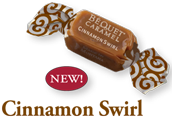
Bequet specializes in caramels and only caramels.  Robin takes pride in making one product very well.  There are 10 flavors including Celtic Sea Salt, Chipotle, and Butterscotch.  These three are the most popular and have won numerous awards. (Celtic Sea Salt is easily the best I have ever tasted, and I am a caramel nut.)  Other flavors include espresso, chocolate, and cinnamon swirl.  Each year they experiment with new flavors, introducing one or two, usually replacing one of the existing flavors.  This year is special though because Bequet is introducing an 11th secret flavor soon.  It was determined that none of the current flavors could be eliminated (without creating havoc), but Robin wanted to continue innovating with new flavors.  The chefs played with several contenders this spring, introducing them to customers of their flagship factory/store in taste tests.  The final decision was influenced greatly by actual customers voicing their opinion of real products.  They are hush hush on the verdict, but indications are that it will be amazing. 

Most of their products are sold as individually wrapped pieces at over 900 retail establishments in the US and Canada.  (On a recent trip to the East Coast, I found them at a small specialty grocery store in North Carolina.)   Some establishments carry gift bags and boxes.  Local chefs are lucky to be able to work with Bequet Caramel Sauce, which is not available for retail purchase (!).  The rest of us can purchase individually wrapped pieces in gift boxes or by the pound at their factory or online store.  Factory visitors can also buy quarter pound end pieces that are the last of a batch that didn’t fit through the wrapping machine.   

In addition to extremely high standards, Bequet does not allow any nut products in the production facility.  They are very strict about this.  So if you are allergic to nuts, but like caramel, this is the product for you.  The caramels are also gluten-free and all natural. Bequet has eliminated GMO ingredients from all products, with the exception of one ingredient that is particularly hard to find of the right quality.  But they are working on this and expect to convert to a new ingredient soon.

Since Bequet doesn’t allow any nuts near the caramel, and I am fond of nuts with my caramel, I found a solution - make your own.  Their end pieces are perfect for this since I can’t duplicate their caramels at home and no other producer comes close.  Take raw pecans (or your favorite nut) and lightly toast them in your oven.  Let these cool and gently warm the end pieces in a skillet over low heat.  When it is just a little malleable, stir in the nuts.  Be quick because you don’t want to cook the caramel or it will become hard and toffee like.  Pour the caramel-nut mix onto a greased glass pan.  (You might not need the “grease”.)  When cool, cut up and enjoy.  Earlier I mentioned that I take pounds of the stuff home with me and this is the reason. 

Recipe for success: High standards and managed growth
During the preceding week, I had exchanged emails with the founder and owner, Robin Bequet.  She started the company in 2001 after the telecom crash at the turn of the century.  She started at home and increased production as friends and family started getting the word out.  During the early days, her family helped with production, including her father and husband.  It wasn’t long before they needed a stand-alone facility.  Now, they are running out of room and are planning an expansion that may double the factory’s size.  Robin manages growth closely.  Since the caramels have a 3 month shelf-life, inventory is meticulously controlled.  This means that the company works directly with most retailing partners to ensure that products are fresh and up to company standards.  They only accept new clients when they know that they and their suppliers can handle an increase in production without compromise.  The result is a product to believe in.


http://www.bequetconfections.com.