Showing posts with label managed growth. Show all posts

Tuesday, July 2, 2013

The Upside of Managed Growth for a Start-Up

The upside of managed growth for a start-up

In a world where fast business growth is applauded, it is easy to forget that it is not the norm. Not that there is anything wrong with fast growth, but what about everyone else?  How many times have you seen companies that grow really fast and then fall flat?  I sometimes save magazine articles, add them to my stack of things to reread, only to find them years later when I am cleaning off my desk. (I know that I am not alone.) What is interesting is the number of companies mentioned that are no longer around. They had a great idea, but couldn’t survive.  There are many reasons for that, but business cessation is a whole other topic that could go on for some time. The obvious tortoise-hare analogy aside, there is something to be applauded about managed growth.  

You may have noticed that the previous blog posts here discuss entrepreneurs who have carefully managed the growth of their companies. Oscar from Landau Confections emphasizes innovation in both product and production, ensuring that the results are truly hand-crafted and original. Cristina from Kika’s Treats was given the opportunity to accelerate growth by mass producing her products, but didn’t want to compromise the quality.  Dandelion Chocolate’s business model specifically focuses on small batch chocolate, isolating the sources to bring out the individual flavors hidden in each harvest.  Robin at Bequet Caramels described her strategy as focusing, “on one niche and make the best product we possibly can in that niche.  We were often asked why we don’t make chocolates, too.  The answer has always been that our goal is to make the best caramel anyone has ever had (period).” 

These companies were chosen not because it is interesting to try new candy, but because each demonstrates a dedication to high-quality products.  Also, each company was given the opportunity to grow quickly, but the owners concentrated on the quality of the product, staying true to their existing customers, and continuing the practices that had succeeded for them. These owners decided early on what mattered to them in the creation and development of their companies.  Individually, they chose a strategy and stayed true to the course. 

Entrepreneurs are often faced with two extreme scenarios – too few options (such as early financing) and too many options (like an overwhelming number of potential suppliers).  Knowing ahead of time what you want your company to represent helps with both situations.  When you don’t have many options, your dedication to your strategy can help spur you to innovate new solutions.  When too many options exist, your knowledge of yourself and the company can help eliminate those choices that don’t align with your long term goals. This is not to say that sometimes compromises aren’t necessary.  However, knowing what you stand for makes decision making during these situations much easier.   

On a side note - Public companies often don’t have the option to manage growth in these ways when shareholders and the SEC require the optimization of shareholder wealth (aka stock prices).  When your business centers on driving down costs to increase profit, it is hard to choose the more expensive route.  Some companies are expected to make compromises that detract from the initial goal since higher quality raw materials, labor intensive production, and higher ethical standards for sourcing often cost more.  When a company targets the mass market who is increasingly concerned about price, executives often believe that they do not have the option to increase prices to off-set higher production costs.  Few companies have been able to do this.  In fact, one of the critiques of the Western business environment is just that, too much emphasis on meeting the quarterly expectations so that the stock price doesn’t drop. 

In turn, costs are minimized to help maximize profit. 
And we buy it.

So, what is the right formula?  You decide.  Every dollar that you spend is your vote.

Get to know the products that you buy and who makes them.  

Saturday, June 22, 2013

Bequet Caramel – All natural, gluten-free, nut-free, and delicious

Bequet Confections 

On my recent adventures traveling, I decided to continue my search for great small businesses.  And my my my.  Montana did not disappoint. This company is not a start-up, but exemplifies managed growth as a core component of a company's strategy.  On the recommendation of Bozeman residents, I visited Bequet Caramel.  This was not my first trip to Bequet, so it was not a surprise that the locals kept acclaiming their products. The Food Network visited in 2010 and raved.  It won’t be my last visit; that is for sure.  These things are fantastic.  Each time I visit, pounds of caramel are loaded into my luggage.  Pounds. 

Lyndsey Althans (left) and I discuss the many flavors of Bequet. 


Bequet Caramels are hand crafted with the highest quality all natural ingredients.  I personally watched them make the caramels with local ingredients that I would want to use at home (if I lived there).  Actually, anyone can watch the processes.  The front room of their flagship factory had huge windows that look right into the kitchen.  It was so clean and organized!  And production was not hidden in some big machine, but in relatively small copper pots.  Each batch is handmade by a team of dedicated, and rather busy, chefs.  Since the founder, Robin Bequet, was out of town, I met with Lyndsey Althans.  She explained that each batch is 41 pounds, or about 1600 pieces.  On average, they go through almost a half-ton of caramels a Day.  Unless it is around the holidays at which time production doubles.  And they check EACH piece for quality control.  A recent batch was too chewy to be considered their “soft” caramels, but too soft to be considered a “chewy” caramel.  This batch was immediately pulled. 


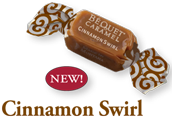
Bequet specializes in caramels and only caramels.  Robin takes pride in making one product very well.  There are 10 flavors including Celtic Sea Salt, Chipotle, and Butterscotch.  These three are the most popular and have won numerous awards. (Celtic Sea Salt is easily the best I have ever tasted, and I am a caramel nut.)  Other flavors include espresso, chocolate, and cinnamon swirl.  Each year they experiment with new flavors, introducing one or two, usually replacing one of the existing flavors.  This year is special though because Bequet is introducing an 11th secret flavor soon.  It was determined that none of the current flavors could be eliminated (without creating havoc), but Robin wanted to continue innovating with new flavors.  The chefs played with several contenders this spring, introducing them to customers of their flagship factory/store in taste tests.  The final decision was influenced greatly by actual customers voicing their opinion of real products.  They are hush hush on the verdict, but indications are that it will be amazing. 

Most of their products are sold as individually wrapped pieces at over 900 retail establishments in the US and Canada.  (On a recent trip to the East Coast, I found them at a small specialty grocery store in North Carolina.)   Some establishments carry gift bags and boxes.  Local chefs are lucky to be able to work with Bequet Caramel Sauce, which is not available for retail purchase (!).  The rest of us can purchase individually wrapped pieces in gift boxes or by the pound at their factory or online store.  Factory visitors can also buy quarter pound end pieces that are the last of a batch that didn’t fit through the wrapping machine.   

In addition to extremely high standards, Bequet does not allow any nut products in the production facility.  They are very strict about this.  So if you are allergic to nuts, but like caramel, this is the product for you.  The caramels are also gluten-free and all natural. Bequet has eliminated GMO ingredients from all products, with the exception of one ingredient that is particularly hard to find of the right quality.  But they are working on this and expect to convert to a new ingredient soon.

Since Bequet doesn’t allow any nuts near the caramel, and I am fond of nuts with my caramel, I found a solution - make your own.  Their end pieces are perfect for this since I can’t duplicate their caramels at home and no other producer comes close.  Take raw pecans (or your favorite nut) and lightly toast them in your oven.  Let these cool and gently warm the end pieces in a skillet over low heat.  When it is just a little malleable, stir in the nuts.  Be quick because you don’t want to cook the caramel or it will become hard and toffee like.  Pour the caramel-nut mix onto a greased glass pan.  (You might not need the “grease”.)  When cool, cut up and enjoy.  Earlier I mentioned that I take pounds of the stuff home with me and this is the reason. 

Recipe for success: High standards and managed growth
During the preceding week, I had exchanged emails with the founder and owner, Robin Bequet.  She started the company in 2001 after the telecom crash at the turn of the century.  She started at home and increased production as friends and family started getting the word out.  During the early days, her family helped with production, including her father and husband.  It wasn’t long before they needed a stand-alone facility.  Now, they are running out of room and are planning an expansion that may double the factory’s size.  Robin manages growth closely.  Since the caramels have a 3 month shelf-life, inventory is meticulously controlled.  This means that the company works directly with most retailing partners to ensure that products are fresh and up to company standards.  They only accept new clients when they know that they and their suppliers can handle an increase in production without compromise.  The result is a product to believe in.


http://www.bequetconfections.com.