Showing posts with label founders. Show all posts

Monday, July 28, 2014

Madame Kayoko Hosokawa – entrepreneur


On July 14th I was honored to attend a Salon hosted by the Japan Society of Northern California at the Consul General of Japan’s home in San Francisco.   At the Salon, Madame Kayoko Hosokawa, the former First Lady of Japan, spoke about her latest endeavors in support of musicians with special needs.  The day before, she had introduced the U.S. Japan Friendship Special (Family) Music Concert, which brought together musicians with autism from Japan and the U.S.  At the Salon, Madame Hosokawa passionately described how she was moved to start advocacy for those with disabilities over 30 years ago when she learned about a young woman who was a Special Olympian from Japan.  Since then, she has worked on several projects to promote equality.  Her efforts include co-foundering the Special Olympics of Nippon in 1994 and producing 4 movies about some of the extraordinary accomplishments of those special needs.

Why am I bringing this up on a blog about entrepreneurship?  Good question.  I do this because I would like to highlight Madame Hosokawa’s endeavors as examples of entrepreneurship that don’t fall into what people often define as entrepreneurship.  The Special Olympics of Nippon was not a brand new idea, but it took a lot of work to create this organization.  And what about films?  A film is not a new firm, but could be considered a new venture. 

What do you consider entrepreneurship? 

Tuesday, June 24, 2014

Pitching a Fit

Today, the F50 held a pitch fest for their first season of firms (http://f50.io/) at the Computer History Museum in Mountain View.  The founders of 25 companies presented their business ideas to over 200 investors along with a large room full of interested business founders and ecosystem participants (e.g. consultants, attorneys, and press).  F50 identified these firms as some of the “most fundable start-ups” and then matched them with investor mentors to help them raise capital.  Thus, it is no surprise that many of these firms have revenues and some have angel or VC funding already.  Many have been through Y-Combinator or (and) 500 StartUps Accelerator. Many founders are serial entrepreneurs.  This is not the typical start-up crowd.  They are experienced, savvy and ready to take on the world. 

“The best of the best of the best, Sir.”

It was a really interesting pitch fest with a wide range of ideas.  Some good, some excellent, some just plain bad. 

Trends:
Almost all of them had something to do with the internet.  If the firm wasn’t completely contained on the internet then they relied heavily on it for reaching customers.  Seven were “platforms”.  Seven were market places (think ebay).  Eight were social such as dating, networking, or photo sharing.  (There is some overlap in these categories.) Other start-ups ideas included on advertising, gaming, and sensors.

What not to do while pitching:

Oh yes – it is back - the list of what not to wear (see previous post).  This time I have included what not to do based on what I saw here and comments that I heard.  I got to sit up front with the investors and VIPs and listen to their comments.  It was hilarious. 

#1 – Don’t dress like a slob.  Seriously.
Holy Guacamole!!
For the love of ironing boards everywhere – get one.  Half of the presenters were dressed like “slobs”.  (Direct quote – I can’t make this stuff up.)  One VC said that he was so distracted by the presenter’s horrible clothes that he completely missed what the company did.  Face it, the dress down look is so 2001.  Actually, if you want to stand out, dress well. All of the investors dressed professionally.  If that is who you are targeting, take note. 

Rule of thumb – First Date Attire or Better.  Dress as least as well as you would on a first date.  That is what this is, your first date with someone with whom you will have a long intimate relationship – if it goes well.  Dirty athletic shoes do not impress.

And do us all a favor – take a shower and shave.

One of these things is not like the other...

#2 – Don’t wait until minute 3 out of 4 to tell us what the firm does. 
We really don’t care if the firm has backing if we don’t know what your product or service is.  Same goes for your pedigree.  Give me a clue of what you’re doing before telling me that you are from Ivy League University. 

#3 – Don’t take your phone.
You think that I am joking.  Nope.  It was probably to help keep time, but boy did it look bad.  How long have I been talking?  Wait, let me look at my phone.  Oh, and Mom called.  (By the way, there is someone in the front row with 1 minute and 30 second left signs.)

#4 – Don’t be mysterious about how you will use the money.
Far too few of the presenters discussed what they would do with an investment.  Just because the firm has traction doesn’t mean that you know how to scale.  For all we know, you will spend all of the next round of funding on t-shirts for marketing.

#5 – Don’t read the slides.
Many venues have the technology that displays your slides in front of you in addition to the larger screen for the audience in back of you.  Unfortunately, some presenters now think that just because the display is in front of them, they can read it like a teleprompter.  Not so much.  And the audience might not know that there is a display on the floor in front of the presenter, so it just looks like he or she is staring at the ground. 

#6 – Don’t go over the time limit.
This is really difficult since the time is so very short.  However, you don’t want to be the one where the organizer walks on stage to usher you off.  The audience understands that you don’t have much time.  The audience is also watching another two dozen presenters (or so).  Don’t be rude.  Share the podium. Play nice. 


Monday, May 19, 2014

And you may contribute a verse...

Last night, the Center for Science, Technology, and Society (CSTS) at Santa Clara University held their first MAGIS Dinner to celebrate leaders in social enterprise development.  The two awards were presented to Graham Macmillan of VisionSpring and the Citi Foundation and Sally Osberg of the Skoll Foundation.  Founders and employees of other social enterprises were also in attendance, as well as dozens of supporters and sponsors.  Some of the amazing social enterprises on hand were Angaza Design, Anudip Foundation, Artisan Connect, Givve Collection, Global Women’s Water Initiative, Good World Solutions, Not for Sale Campaign, Nokero, Sankara, Smart Voter, Twothirds Water, World Wide Hearing, and Nazava Water Filters.

What is social enterprise?  People argue about the definition all the time, but it basically comes down to organizations using traditional business practices to solve problems of social welfare.  That means that social enterprises and the people in them are changing the world to be a better place. 

Seeing the work that these people do is both inspiring and humbling.  Most of the time, I sit at my desk overwhelmed by the evil in the world.  Reading the paper and online news gets more difficult each day with the sheer volume of violence and cruelty reported both locally and worldwide.  Heck, I can’t even drive down the street without getting cut off by someone who must be more important than me and is in a very big hurry (I picture that he has to go to the bathroom… and hope that he doesn't make it).  I admit that I vacillate between feeling helpless to why bother.

So, sitting in a room of people who make it their life’s work to make a difference is astonishing. It reminds me that there are good people and the world need more of them.  And when I think that one person can’t make a difference, I can think about this – if Dr. Stanley Zlotkin hadn't started Sprinkles Global Health Initiative, millions of children would be malnourished. If Joseph Adelegan hadn't started Cows to Kilowatts, thousands would be suffering the ill effects of water contamination by slaughterhouse waste.  If Jordan Kassalow and Scott Berrie hadn't started VisionSpring, there would be almost 2 million people who can’t see.  One person matters.

I couldn't help but reflect on my own contribution to society when listening to the stories and feeling rather guilty.  But then, my husband reminded me, we all can contribute in our own ways.  And no, we might not be the next contender for the Nobel Peace Prize or MAGIS Award, but that isn't the point. 

As Ol’ Walt said, “the powerful play goes on, and you may contribute a verse.”   
-----

FYI - The CSTS has the Global Social Benefit Institute (GSBI) that helps social enterprises develop and grow.  They estimate that the over 200 organizations that have completed the program in the last 11 years have reached over 100 million people at the base of the pyramid.  The GSBI is the cornerstone of the CSTS.  Graham Macmillan is a graduate of the GSBI.  Other exemplary organizations in his cohort include Kiva, Sprinkles Global Health, Cows to Kilowatts, and Whirlwind Wheelchair.  Sally Osberg is the President and CEO of the Skoll Foundation, which invests directly in social enterprises such as Girls Not Brides, B-Labs, Global Witness, Medic Mobil, Kiva, One World Health and VisionSpring. They also support organizational development through programs and partnerships.  They have a new film that summarizes their mission at skollworldforum.org.

Shout out to TestaRossa Wines, REBBL Tonic, and Pisco Porton for their generous donation of terrific libations. 

Wednesday, April 9, 2014

The World of Entrepreneurship

Over the last couple of months I have been catching up on some travelling, flying to Tel Aviv and Paris to continue my adventures.  No matter where I went, I couldn't help but be struck by the entrepreneurship in every location.  This is no surprise being someone who studies entrepreneurship for a living. But even after all of these years, I couldn't help but be intrigued by the similarities and differences of new ventures around the world.

Take Tel Aviv for example.  What an amazing city of history and innovation!  In the same block that you have a historic site of biblical importance there is a start-up working on the latest technology.  It was inspiring to see a government that promoted not only entrepreneurship, but also the vital infrastructure necessary for start-ups to survive.  They are working to attract funding sources from around the world including venture capitalists and large financial organizations.  Unfortunately, the World Bank ranks the country in the lower half of all countries for registering property, getting electricity, and dealing with construction permits.  And it was obvious that some parts of the country are more developed than others, but by and large - infrastructure was great.  And Israel ranks highly in investor protection, international trade and ease of starting a firm.   (http://www.doingbusiness.org/data/exploreeconomies/israel).  Corporate tax rates are 25% and firms only pay about 5% in social security contributions. The US corporate tax rate tops out at 34% and the social security contributions are only slightly higher at 6.2%. 

In contrast, people that I spoke to in France said that it is very difficult to start a company there.  It is not the red tape, although the counties is ranked low for the ease of registering property.  This biggest complaint was the cost of hiring and paying employees.  Employer paid social security contributions are about 40% of one's salary.  40%! On top of that, firms pay a payroll tax of 5.45%.  Then, the corporate tax rate is 33.33%.  Think of the implications - a firm hires someone at $50K, but ends up paying $72.5K before being hit by corporate taxes.  Even with the strong infrastructure, education, and technology (and pastries), the cost of running a company is high.  Many companies choose to remain small to survive. 

So the next time you take a trip, look at the local companies.  Start-up success is as much influenced by the people who start and run firms as the infrastructure on which it relies.  

Thursday, February 13, 2014

Chocolate is back


What would you do to create the perfect product?  How about take 5 flights, canoe for 5 hours through the Amazon, and then trek 15 kilometers through the Bolivian jungle?  That is what it takes just to get the raw cacao for Oialla chocolate.  And we haven’t even started to discuss production yet.  And Rasmus Bo Bojesen, the owner of Oialla and chocolatier, will not settle for less.

This all started a few years ago when Rasmus’ wife asked him one morning why
they didn’t make organic chocolate.  This question didn’t come out of the blue.  Rasmus is a world-renowned chef and restaurateur who owns Axelborg and The Royal Danish Opera Restaurant.  (He has started several other restaurants throughout Denmark.)  His obsession with chocolate started over thirty years ago while working as a chef at Michelin star restaurants and as an apprentice to Lyon master-chocolatier Bernachon. Since then he has studied chocolate.  When I write studied, I mean that the man should have a doctorate in cacao if there were such a thing.  In addition to making and selling chocolate and delicacies in his restaurants and shops over the years, he started Bojesen Chocolate, which produced raw chocolate, in 2006.  And then he wrote a cookbook, “A Sense for Chocolate” that was published in 2009 (for which he won the Gourmand Best Chocolate Book in the World Award in 2012).  When he talks about chocolate, he beams as though nothing else in the world matters. 

So when his wife asked about making organic chocolate, Rasmus’ response was “Three reasons. Taste. Taste. And Taste.”  At that time organic cacao beans had a reputation for poor quality.  The supply of organic cacao was extremely limited and not consistent. But the couple was up for the challenge.  They talked with friends and colleagues, including an agriculture professor nearby that suggested that the cacao they were searching for may exist in the wild and only in the jungles of Bolivia.  After a lot of research, a small protected area was located that had virtually untouched cacao trees around Baures in the Beni region of Bolivia.  And they weren’t exporting the beans. 


This is where the 5 flights, 5 hours canoeing, and 15 km hike come in.  There was no assurance that Bolivia would have the quality of beans that Rasmus demanded.  In fact, he didn’t have proof that this raw material even existed. First, Rasmus met with locals who worked with Bolivian wild cacao harvesters. He then went to the sites to taste the beans and meet the workers.  He was surprised by what he found, an impressive bean with no acidity and bitterness that is usually associated with raw cacao.  He had found his bean.  And it doesn’t get more organic.  These trees have not been cultivated, fertilized, or treated with herbicides. The pods that are produced are about half the size of traditional pods, but hold much better flavor.  These are among the few beans that I have tasted that are not bitter.  They have a solid cacao flavor without the harsh aftertaste. 


Social entrepreneurship


When asked about gaining the trust of the Bolivian farmer, Rasmus shook his head.  “There are no farmers.  There are no farms.  This is the jungle.”  Trust was a big deal.  After working with the beans, he found that the fermenting and roasting process needed a small change.  However, this change flew in the face of what had been done by the locals for generations.  Thus, the relationship with the workers was critical to success. Additionally, the chocolate industry is notorious for the obscene use of child and slave labor. Since the location was deep in the jungle, it would have been easy for a company to come in and exploit those who live there.  Oialla now works with the Danish Foreign Ministry to set and ensure high standards for working conditions. 

Innovation

Working with these beans has not been easy. As I mentioned earlier, the pods are smaller and the beans have a different flavor than traditional beans.  This cacao also has more cocoa butter.  Thus, the traditional ways of making chocolate did not work.  New recipes needed to be perfected before products were ready.  Initial products were launched in 2010 and in less than a year, Oialla won an award from the “Academy of Chocolate.”  Later in 2011, they won the Gold in Great Taste Awards.  In 2012, Rasmus was invited to a small conference with the most talented chocolate makers in the world.  Although impressed with Oialla, a colleague asked why he didn’t get the entire flavor from the bean.  Puzzled, Rasmus went back to the kitchen and spent almost a year refining the manufacturing process.  He says that he now understands what his colleague meant.  The 78% chocolate now has a fuller flavor that captures more of the nuances of the Beniano beans. 

The product

When I visited Oialla, I was offered a beautiful tray of chocolate to taste, first the solid wafers and then the truffles and nuts.  Bottom line - Oialla chocolate is so good that I actually felt guilty eating it.  There were so many wonderful choices.  Now, I wish that I had taken the whole plate, thrown it in my bag and ran out with the treasures.  I knew that you could buy the chocolate wafers, but now I find out that the truffles and other chocolates are not sold.  Cruel cruel world.


At first, Oialla was produced as 72% and 78% dark chocolates (percent of cacao solids).  They just started producing a 46% milk chocolate.  Although chocolate snobs often look down at the lighter versions of chocolate, this milk is for the connoisseur. Rasmus made a subtle, but genius change to the manufacturing process that takes this milk chocolate to another level. I can’t tell you the secret, but it is brilliant.    
  

Recipe for success: Passion

What does every entrepreneur need? Passion. Everywhere you turn, people who are talking about successful entrepreneurs talk about passion.  But, what is passion?  The dictionary uses synonyms such as intense, driving, overwhelming conviction, strong desire, and enthusiasm. 

Passion is what gets you through the unforeseen difficulties and challenges, and there always are some.  In talking with Rasmus, you can’t help but understand his need to make the best product that he can, whether it be gourmet meals or organic chocolate.  He is also witty and down to earth, breaking out the beautiful photo book that his wife produced after their last trip to Bolivia with their children. It is a terrific combination that has served him well.  We may very well find Rasmus’ photo under passion in the dictionary.


Sunday, November 17, 2013

Crowdfunding article Posted!- Part 2 (of 3)

Check out the crowdfunding page.

I have finally added Part 2 that discusses the nuts and bolts of crowdfunding Campaigns.  The article talks about the description, video, value to the investor, online presence, fulfillment and more.

Part 3 is coming soon - Caveats.  Stay tuned!

Saturday, October 12, 2013

Inspiration Found Here - Three Ring Ranch Exotic Animal Sanctuary

Three Ring Ranch Exotic Animal Sanctuary
Inspiration found here

This entry strays a bit away from the theme of young companies.  However, it is such an incredible story that I have to tell you about it. 

Three Ring Ranch Exotic Animal Sanctuary was started in 1998 by Ann and Norm Goody.  Before starting the sanctuary, Ann was an emergency room nurse and administrator at a home health agency.  Norm was an anesthesiologist.  They met in 1997 while Ann was working on her doctorate health care administration.  That June, the couple married.  The next day, Ann was struck by lightning.  

Literally.

Recovery wasn’t easy and part of Ann’s temporal lobe was removed.  After relearning to walk and talk, Ann amazingly returned to work in health care.  Always the animal lover, Ann joked that she would like a zebra to help her recover.  In 1998, the Moloka‘i Ranch Safari Park closed its doors. Norm contacted the Safari Park and since the couple was licensed to care for wild animals, they were invited to choose among the animals that were about to be abandoned.  They found Oreo and Zoe, her new foal. Zoe is a brilliant blonde zebra, one of two known to exist in captivity in the world.  With Zoe, Oreo, and a few other rescuees, Three Ring Ranch Exotic Animal Sanctuary was born.  The Goody’s turned their 5-acre lot on the Big Island into what is today Hawai‘i’s sole federally accredited nonprofit exotic animal sanctuary, one of only thirty-three in the country.

Ann and Norm continued to work their health care for several years to support themselves and the Sanctuary.  Ann decided to focus on the Sanctuary full time after another health scare prompted her to change her life.  Norm followed a few years later.  Now they run the Sanctuary full time and support themselves with their savings.  And by run, I mean care, feed, and rehabilitate hundreds of animals.  Ann and Norm (and others) spend years rehabilitating animals. They know the personal story of each of the residents and are genuinely concerned with their well-being.  And not only do they have the knowledge to care for these animals, Ann is especially adept at understanding animal behavior. Our conversations gave me more insight into animal behavior than any book I have read or tv show I have watched. 

Over the last 15 years, the Goody’s have cared for over 100 types of animals, with more than 50 types in residence at any one time.  Many roads lead animals to the Sanctuary; often tragic.  For example the Sanctuary has rescued animals from failed zoos and directly from owners who can no longer care for them.  Several abandon or abused animals and injured wild animals have also been placed there.  If at all possible, wild animals are rehabilitated and returned to their natural habitat.  Otherwise, the Sanctuary provides a life that is similar to their natural environment.  Each is researched extensively and cared for with acute attention to distress and mental harmony. Animals are often paired with other seemingly dissimilar animals according to behavioral needs.  For example a North American bison was recently paired with a feral donkey who became best friends.  Turtles and tortoises calm distrusting birds around the grounds.  One of the goals is to create an environment in which each animal can live closely to how they would in the wild.

Also impressive are the Sanctuary’s educational endeavors.  The facility is a role model for education and animal care. They work with UC Davis, UC Berkeley, and Oregon State University providing pre-vet internships to undergraduate university students.  So far, each of their interns has been successfully placed in a competitive veterinary program.  Second-year vet students can visit as part of summer programs.  The Sanctuary also provides an after school mentoring program for younger students in local schools, focusing on children between 12 and 13.  They offer various classes to students between 8 and 11.  Community lectures have been provided as well.  The Sanctuary is a non-profit organization, supported only by donations.  It is run by volunteers and no salaries are provided for anyone.

The mission of the Sanctuary is not to be a petting zoo.  In fact, it is not open to the public, but they will provide small private educational tours.  She teaches visitors that animals have their own unique ways of communicating.  She shows you how we often misinterpret their behaviors because we do not understand their language.  If you are lucky enough to visit and learn from Ann, you might make friends with an alpaca by pressing noses, shake hands with a monkey, or be greeted by a 1500 pound bison licking your hand.  No matter what, it is an experience that you will never forget. 

Monday, September 16, 2013

Building Product and Infrastructure from Scratch

Original Hawaiian Chocolate Factory


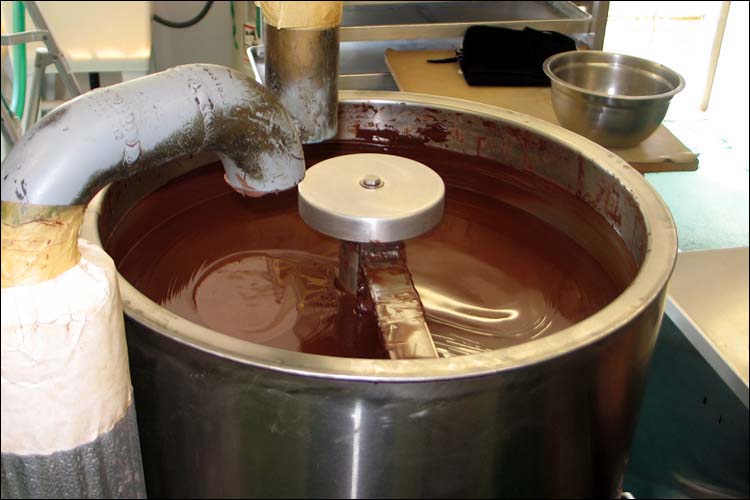
Pam and Bob Cooper moved to the Big Island of Hawaii in 1997 after Bob left a career in country club management in North Carolina.  Their philosophy was that bad things happen everywhere in life.  Where is a better place to experience the good and bad than in Hawaii?  Terrific point.  What happened next was a little less obvious.  With little experience in agriculture, the couple bought a small farm with coffee, macadamia nut and cacao trees in Keauhou, Hawaii (near Kona).  Originally, they had planned to cultivate the existing macadamia nuts and build a business; however a family member’s allergy to the product dampened the enthusiasm.  They turned to the cacao trees and in 1999 founded the Original Hawaiian Chocolate Factory.  Their first batch of chocolate was sold in 2000.    


In the last 14 years, the Coopers have grown OHCF to sell over 10,000 pounds of chocolate a year.  That is 5 tons of chocolate all made in small batches on site!  When they opened, few companies made chocolate in Hawaii and most used cacao from around the world.  The infrastructure for the chocolate industry did not exist in Hawaii. Attempts had been made, but there was little success. In fact, no testing facilities existed nearby to rate the beans, so the Coopers sent them to Spain.  They brought in the processing equipment from around the world.


As a specialty item, no retailers carried 100% Hawaiian chocolate.  (The only other company was Hawaiian Vintage Chocolate founded by Jim Walsh in 1986.)  The Coopers set up their distribution and retail sales network from scratch.  Several plantations grow cacao in Hawaii, but they do not process or manufacture the chocolate themselves.  In addition to their six acres of cacao, OHCF purchases cacao from over 30 local farms. The closest competitor is the Dole Plantation that grows 20 acres of cacao in Waialua, Hawaii (Oahu), which is processed and sold by Guittard Chocolate Company.  Currently, no other company has the entire chocolate making process from growing the beans to sales (“tree to bar”) in the country.  This was not by design, but necessity.  The process did not exist, so the Coopers had to make it.  Also, the company did not have a pool of experienced industry mentors on the island.  They worked with farmers and retailers to create a viable value chain in one place.  Thus, a lot of their initial work wasn't just making prototypes of a sellable product, but also included building the market.


The company is a family affair.  Much of the harvesting and processing is still done by the Coopers.  Currently, OHCF sells only single-origin chocolate and cacao nibs.  They do not produce truffles or other chocolate items and do not sell wholesale. Unlike Dandelion Chocolate, OHCF does add cocoa butter, sugar, vanilla powder and/or milk powder to their cacao for taste and stability.  The final product is a smooth and consistent chocolate. 


www.ohcf.us

Wednesday, July 24, 2013

What Not to Wear

There seems to be a few interesting myths floating around about start-up styles.  I was reminded of this at a pitchfest recently.  Pitchfests are short events, usually a couple of hours, at which about a dozen companies have three to ten minutes each to convince the audience and sometimes judges that their companies are wonderful businesses and that they should be funded.  Pitchfests can be terrific for refining your story or connecting with potential investors, mentors, and customers.  There are very few opportunities where a company founder can talk to a room full of people who actually want to hear about the idea.  However, before a word comes out, you better believe that an impression has already been made.  Many people forget that clothing and body language speak volumes.  No, you don’t have to be the best dressed or have the perfect stage presence, but you do have to look like you care.  Here are a few tips about what not to wear.

1.   Backwards baseball hat, or any hat for that matter.  Even in Silicon Valley, a backwards baseball hat is sure to make audience members snicker and roll their eyes.  It doesn’t matter if it has the company’s name on it, it doesn’t look good.  It is very difficult to listen to a CEO when you are wondering if they just woke up.  And if someone can’t wake up in time for a mid-afternoon presentation, how do they run a company?

2. Sweatpants.  ‘nough said.

3. The hoodie.  That is so 2007.  Do you really expect us to believe that you are the next Facebook?  Even if you are, we don’t care. 

4. Sunglasses.  See hat.

5. College paraphernalia.  I love my alma mater, but wearing my favorite college sweatshirt to talk with investors is a flag of insecurity.  “Really, I went to this school and you should be impressed.”  Or not.  Save this one for grocery shopping. 

6. Haute couture or expensive designer wear.  If you are talking to potential investors you are asking for money.  You are asking for money to pay your salary.  Why should they pay you to wear better clothing than most actors unless you are starting a fashion company? 

7. Gum.  Warning.  Don’t sit in the first row. You may get hit by projectile gum during the presentation.  It happens. 

8. Shorts or skinny jeans.  Whoa nelly.  This distraction just makes one wonder which season it is. Is this pitch for a resort?  Leg hair removal?  Liposuction?  Plus, not many people can wear these and look professional. 

9. Gimmicks. It is one thing to dress in clothes that reflect the nature of the market in which you do business.  There is a fine line between looking cute and looking stupid.  Even if your app is the must have for skateboarders, dressing like Hawk or White mid-tre flip is not going to show others that you can run a company.  Just don’t go there. 

10. Goggles – No, I am not kidding.  And it wasn’t even a gimmick. 

11. Dirt.  Unconsciously, people connect cleanliness and competence.  This means, don’t eat spaghetti before talking with others.  Since I am prone to spills, I shy away from wearing white.  It is sure to end poorly. 

12. Like any teenager you know, even if you are a teenager.  You are not, nor will you ever be, the coolest person in the room.  Stop trying to be.   

And last, but certainly not least…

13. Smug smile.  Why are you here?

As in any situation, it is your job to convince the audience of your story.  Part of this is how you dress. If you were trusting a stranger with thousands, if not millions, of dollars, how would you want them to look?  Be respectful.