Wednesday, July 24, 2013

What Not to Wear

There seems to be a few interesting myths floating around about start-up styles.  I was reminded of this at a pitchfest recently.  Pitchfests are short events, usually a couple of hours, at which about a dozen companies have three to ten minutes each to convince the audience and sometimes judges that their companies are wonderful businesses and that they should be funded.  Pitchfests can be terrific for refining your story or connecting with potential investors, mentors, and customers.  There are very few opportunities where a company founder can talk to a room full of people who actually want to hear about the idea.  However, before a word comes out, you better believe that an impression has already been made.  Many people forget that clothing and body language speak volumes.  No, you don’t have to be the best dressed or have the perfect stage presence, but you do have to look like you care.  Here are a few tips about what not to wear.

1.   Backwards baseball hat, or any hat for that matter.  Even in Silicon Valley, a backwards baseball hat is sure to make audience members snicker and roll their eyes.  It doesn’t matter if it has the company’s name on it, it doesn’t look good.  It is very difficult to listen to a CEO when you are wondering if they just woke up.  And if someone can’t wake up in time for a mid-afternoon presentation, how do they run a company?

2. Sweatpants.  ‘nough said.

3. The hoodie.  That is so 2007.  Do you really expect us to believe that you are the next Facebook?  Even if you are, we don’t care. 

4. Sunglasses.  See hat.

5. College paraphernalia.  I love my alma mater, but wearing my favorite college sweatshirt to talk with investors is a flag of insecurity.  “Really, I went to this school and you should be impressed.”  Or not.  Save this one for grocery shopping. 

6. Haute couture or expensive designer wear.  If you are talking to potential investors you are asking for money.  You are asking for money to pay your salary.  Why should they pay you to wear better clothing than most actors unless you are starting a fashion company? 

7. Gum.  Warning.  Don’t sit in the first row. You may get hit by projectile gum during the presentation.  It happens. 

8. Shorts or skinny jeans.  Whoa nelly.  This distraction just makes one wonder which season it is. Is this pitch for a resort?  Leg hair removal?  Liposuction?  Plus, not many people can wear these and look professional. 

9. Gimmicks. It is one thing to dress in clothes that reflect the nature of the market in which you do business.  There is a fine line between looking cute and looking stupid.  Even if your app is the must have for skateboarders, dressing like Hawk or White mid-tre flip is not going to show others that you can run a company.  Just don’t go there. 

10. Goggles – No, I am not kidding.  And it wasn’t even a gimmick. 

11. Dirt.  Unconsciously, people connect cleanliness and competence.  This means, don’t eat spaghetti before talking with others.  Since I am prone to spills, I shy away from wearing white.  It is sure to end poorly. 

12. Like any teenager you know, even if you are a teenager.  You are not, nor will you ever be, the coolest person in the room.  Stop trying to be.   

And last, but certainly not least…

13. Smug smile.  Why are you here?

As in any situation, it is your job to convince the audience of your story.  Part of this is how you dress. If you were trusting a stranger with thousands, if not millions, of dollars, how would you want them to look?  Be respectful.  
   

Tuesday, July 16, 2013

On the road again

This last week, my husband and I took a road trip from San Jose to San Diego for a business meeting.  Before we left, I researched several young companies for consideration in this blog. A list of young companies (less than five years old) was created using web searches and local press.  My plan was to visit the companies during the road trip, meet with owners and managers, and gather information about their strategies for success.  This time, since a girl has to eat on the road, the list focused on bakeries.  All in the name of research.

What surprised me most wasn’t the fantastic companies that will be discussed in future entries.  It was actually the companies that were taken off the list.  Let me clarify something here. I don’t get paid to visit companies or write about them.  The products sampled are usually purchased by me, unless I happen to be on the factory floor and sampling is part of a tour or something.  Objectivity is paramount.  What you get here are my observations on what makes start-ups succeed and examples of potential weaknesses.   

For example, a bakery near San Diego has a recipe for success with a perfect location and a lot of foot traffic.  However, the product that I had was, quite honestly, inedible. (I am not one to throw away food, but I couldn’t finish that cupcake to save my life.)  Additionally, the menu was remarkably limited with very limited product on display, and the hours were short. On the one hand, just because a company exists doesn’t mean that it is successful.  On the other hand, there are many factors that I did not observe.   

Another bakery had a decent amount of press and a great website - two items in the plus column.  In contrast with the other bakery, the central coast had a huge range of products, um… if you like donuts.  Fun donuts of all flavors from traditional old fashioned to maple bacon logs - three items in the plus column.  But in no way, shape, or form does one appreciate flies on food.  Nope.  My co-pilot almost ran for the door.  Undaunted, I got a couple of things that looked the least likely to have been visited by airborne insects.  After missing lunch, I tried one of the donuts.  Unremarkable.  Ok – I liked the chocolate frosting, but the donut itself was just there.  We tried the other one.  Not even unremarkable.  As hungry as I was, I put away the pastries.  (In the end, they ended up in the trash.  Don’t tell my mom.)    
                                                                                                    
Just like our judgment of food, success is subjective.  The customers of the donut shop may love the crazy flavors and maybe I was there on an off day.  To the locals, this place may be hugely successful if it is revitalizing a neglected neighborhood or building community by bringing people together.  To the owners, it may be a success if it is not losing money.  To others, they may expect the next Dunkin or Krispie.  It is all relative.  So – your question for the week…  


What do you consider success?

Tuesday, July 2, 2013

The Upside of Managed Growth for a Start-Up

The upside of managed growth for a start-up

In a world where fast business growth is applauded, it is easy to forget that it is not the norm. Not that there is anything wrong with fast growth, but what about everyone else?  How many times have you seen companies that grow really fast and then fall flat?  I sometimes save magazine articles, add them to my stack of things to reread, only to find them years later when I am cleaning off my desk. (I know that I am not alone.) What is interesting is the number of companies mentioned that are no longer around. They had a great idea, but couldn’t survive.  There are many reasons for that, but business cessation is a whole other topic that could go on for some time. The obvious tortoise-hare analogy aside, there is something to be applauded about managed growth.  

You may have noticed that the previous blog posts here discuss entrepreneurs who have carefully managed the growth of their companies. Oscar from Landau Confections emphasizes innovation in both product and production, ensuring that the results are truly hand-crafted and original. Cristina from Kika’s Treats was given the opportunity to accelerate growth by mass producing her products, but didn’t want to compromise the quality.  Dandelion Chocolate’s business model specifically focuses on small batch chocolate, isolating the sources to bring out the individual flavors hidden in each harvest.  Robin at Bequet Caramels described her strategy as focusing, “on one niche and make the best product we possibly can in that niche.  We were often asked why we don’t make chocolates, too.  The answer has always been that our goal is to make the best caramel anyone has ever had (period).” 

These companies were chosen not because it is interesting to try new candy, but because each demonstrates a dedication to high-quality products.  Also, each company was given the opportunity to grow quickly, but the owners concentrated on the quality of the product, staying true to their existing customers, and continuing the practices that had succeeded for them. These owners decided early on what mattered to them in the creation and development of their companies.  Individually, they chose a strategy and stayed true to the course. 

Entrepreneurs are often faced with two extreme scenarios – too few options (such as early financing) and too many options (like an overwhelming number of potential suppliers).  Knowing ahead of time what you want your company to represent helps with both situations.  When you don’t have many options, your dedication to your strategy can help spur you to innovate new solutions.  When too many options exist, your knowledge of yourself and the company can help eliminate those choices that don’t align with your long term goals. This is not to say that sometimes compromises aren’t necessary.  However, knowing what you stand for makes decision making during these situations much easier.   

On a side note - Public companies often don’t have the option to manage growth in these ways when shareholders and the SEC require the optimization of shareholder wealth (aka stock prices).  When your business centers on driving down costs to increase profit, it is hard to choose the more expensive route.  Some companies are expected to make compromises that detract from the initial goal since higher quality raw materials, labor intensive production, and higher ethical standards for sourcing often cost more.  When a company targets the mass market who is increasingly concerned about price, executives often believe that they do not have the option to increase prices to off-set higher production costs.  Few companies have been able to do this.  In fact, one of the critiques of the Western business environment is just that, too much emphasis on meeting the quarterly expectations so that the stock price doesn’t drop. 

In turn, costs are minimized to help maximize profit. 
And we buy it.

So, what is the right formula?  You decide.  Every dollar that you spend is your vote.

Get to know the products that you buy and who makes them.  

Saturday, June 22, 2013

Bequet Caramel – All natural, gluten-free, nut-free, and delicious

Bequet Confections 

On my recent adventures traveling, I decided to continue my search for great small businesses.  And my my my.  Montana did not disappoint. This company is not a start-up, but exemplifies managed growth as a core component of a company's strategy.  On the recommendation of Bozeman residents, I visited Bequet Caramel.  This was not my first trip to Bequet, so it was not a surprise that the locals kept acclaiming their products. The Food Network visited in 2010 and raved.  It won’t be my last visit; that is for sure.  These things are fantastic.  Each time I visit, pounds of caramel are loaded into my luggage.  Pounds. 

Lyndsey Althans (left) and I discuss the many flavors of Bequet. 


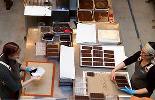
Bequet Caramels are hand crafted with the highest quality all natural ingredients.  I personally watched them make the caramels with local ingredients that I would want to use at home (if I lived there).  Actually, anyone can watch the processes.  The front room of their flagship factory had huge windows that look right into the kitchen.  It was so clean and organized!  And production was not hidden in some big machine, but in relatively small copper pots.  Each batch is handmade by a team of dedicated, and rather busy, chefs.  Since the founder, Robin Bequet, was out of town, I met with Lyndsey Althans.  She explained that each batch is 41 pounds, or about 1600 pieces.  On average, they go through almost a half-ton of caramels a Day.  Unless it is around the holidays at which time production doubles.  And they check EACH piece for quality control.  A recent batch was too chewy to be considered their “soft” caramels, but too soft to be considered a “chewy” caramel.  This batch was immediately pulled. 


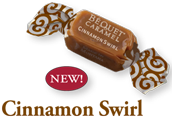
Bequet specializes in caramels and only caramels.  Robin takes pride in making one product very well.  There are 10 flavors including Celtic Sea Salt, Chipotle, and Butterscotch.  These three are the most popular and have won numerous awards. (Celtic Sea Salt is easily the best I have ever tasted, and I am a caramel nut.)  Other flavors include espresso, chocolate, and cinnamon swirl.  Each year they experiment with new flavors, introducing one or two, usually replacing one of the existing flavors.  This year is special though because Bequet is introducing an 11th secret flavor soon.  It was determined that none of the current flavors could be eliminated (without creating havoc), but Robin wanted to continue innovating with new flavors.  The chefs played with several contenders this spring, introducing them to customers of their flagship factory/store in taste tests.  The final decision was influenced greatly by actual customers voicing their opinion of real products.  They are hush hush on the verdict, but indications are that it will be amazing. 

Most of their products are sold as individually wrapped pieces at over 900 retail establishments in the US and Canada.  (On a recent trip to the East Coast, I found them at a small specialty grocery store in North Carolina.)   Some establishments carry gift bags and boxes.  Local chefs are lucky to be able to work with Bequet Caramel Sauce, which is not available for retail purchase (!).  The rest of us can purchase individually wrapped pieces in gift boxes or by the pound at their factory or online store.  Factory visitors can also buy quarter pound end pieces that are the last of a batch that didn’t fit through the wrapping machine.   

In addition to extremely high standards, Bequet does not allow any nut products in the production facility.  They are very strict about this.  So if you are allergic to nuts, but like caramel, this is the product for you.  The caramels are also gluten-free and all natural. Bequet has eliminated GMO ingredients from all products, with the exception of one ingredient that is particularly hard to find of the right quality.  But they are working on this and expect to convert to a new ingredient soon.

Since Bequet doesn’t allow any nuts near the caramel, and I am fond of nuts with my caramel, I found a solution - make your own.  Their end pieces are perfect for this since I can’t duplicate their caramels at home and no other producer comes close.  Take raw pecans (or your favorite nut) and lightly toast them in your oven.  Let these cool and gently warm the end pieces in a skillet over low heat.  When it is just a little malleable, stir in the nuts.  Be quick because you don’t want to cook the caramel or it will become hard and toffee like.  Pour the caramel-nut mix onto a greased glass pan.  (You might not need the “grease”.)  When cool, cut up and enjoy.  Earlier I mentioned that I take pounds of the stuff home with me and this is the reason. 

Recipe for success: High standards and managed growth
During the preceding week, I had exchanged emails with the founder and owner, Robin Bequet.  She started the company in 2001 after the telecom crash at the turn of the century.  She started at home and increased production as friends and family started getting the word out.  During the early days, her family helped with production, including her father and husband.  It wasn’t long before they needed a stand-alone facility.  Now, they are running out of room and are planning an expansion that may double the factory’s size.  Robin manages growth closely.  Since the caramels have a 3 month shelf-life, inventory is meticulously controlled.  This means that the company works directly with most retailing partners to ensure that products are fresh and up to company standards.  They only accept new clients when they know that they and their suppliers can handle an increase in production without compromise.  The result is a product to believe in.


http://www.bequetconfections.com.

Friday, June 14, 2013

Cocoa + Sugar = Heaven (aka Dandelion Chocolate)

Cocoa + Sugar = Heaven (aka Dandelion Chocolate)
Simplicity really is best.

Dandelion Chocolate combines cocoa beans and sugar to produce bars of extraordinary character and complexity.

Simple and Pure.

And when I write cocoa beans and sugar, I mean ONLY cocoa beans and sugar.  No preservatives, stabilizers, or other unpronounceable additives.  That is what makes it so great.  I love the fact that their chocolate is so simple.  The founders, Todd and Cam, go old school on this recipe and it pays off.  In fact, in less than three years they have moved from their personal garage shop to their Mission District Factory and Café.  And just walking into their new café in the Mission District of San Francisco is ethereal.  You are hit with a wave of chocolate air that carries you past the chairs and tables to a small counter filled with rich pastries and luxurious beverages.  Three types of hot cocoa can’t be bad.


Let’s start with the chocolate.
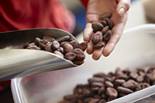
Everything about Dandelion Chocolate says quality and care.  The company purchases the raw cocoa beans directly from the farmer.  In many cases, team members have visited the farm and met the workers. They ensure that the farmers are getting a fair price for their beans and that the farms are up to Dandelion’s quality standards. Once back at the factory, they keep the beans from different farms separated because the flavor of the beans varies widely.  Todd explained that chocolate can differ for many reasons even within one farm. 
The beans are cleaned, roasted, and sorted in-house. Dandelion Chocolates are made in small batches, variant on the location and farm from which the beans originated. The labels reflect specific information about the origin and flavor of the chocolate, which is unique to each batch. Each bar is made by hand.


Just like wine, if you find a harvest that you love, buy a lot.  Unfortunately, the shelf-life of chocolate is not as long as wine, so you will just have to enjoy it.  (Darn.)

Recipe for success: perseverance
Obviously, this labor intensive process in difficult and expensive. As such, Dandelion Chocolate is one of the few bean-to-bar chocolate companies in the Bay Area.  The company was created by two friends, Todd Masonis and Cameron Ring, who founded and sold Plaxo, a personal online address book and forerunner to social networking in 2008. Afterwards, they decided to explore the world of chocolate.  They started by experimenting in a garage and building their own equipment when off-the-shelf wouldn’t work (so Silicon Valley).  A year later, they decided to make a company out of their experimentation.  Growth has been steady and they have learned a lot along the way.  When they opened their café last year, the incredibly fast growth was difficult to manage.  The owners did not have experience running a café.  When the WSJ ran an article near the holidays in 2012, sales skyrocketed.  They had just launched their café and basically sold out. 

The founders now balance economies of scale and their small product line.  For instance, large quantities of pre-printed labels are not feasible since batch sizes vary depending on the raw materials provided directly from the farmers.  Thus, they buy in bulk when feasible and then move production and finishing in house.  They also try to use sustainable materials from high quality sources.  For example, Dandelion has the wrappers made in India from recycled shirts!  The simple, elegant designs are perfectly fitting for the products. 

A recent development: the café invites local guest pastry chefs to transform the chocolate into decadent desserts.


Yum.
Dandelion Chocolate  740 Valencia Street SF CA 

Monday, June 10, 2013

Hey Honey Cakes... Kika's Treats

Kika’s Treats are yummy goodies that you won’t find anywhere else.  Seriously.  I had never heard of honey cakes before finding Kika’s, let alone chocolate covered Brazilian honey cakes.  For those of you still in the dark, Brazilian honey cakes are small, dense, slightly sweet pastries with a brownie-like consistency.  They are similar to a blondie, but without the chocolate chips.  Ok – now Kika’s covers these in chocolate. Viola.


As a caramel addict, I was skeptical at first, but my favorite Treats are the Crunchy Caramels.  They start with a traditional caramel recipe, but use coconut palm sugar and add puffed brown rice. Brown rice? Again – I was skeptical.  They are so good that they don’t even need the chocolate coating, (what am I saying – there is a definite cocoa protocol followed here). If that doesn’t intrigue you, then try the Caramelized Graham Crackers, also covered in chocolate.  They are made by hand in small batches and baked in a small oven in the shop.  


Recipe for Success: High Standards
Kika’s Treats was started by Cristina Arantes 2006.  Since then Cristina has grown the business organically in the Bay Area through specialty shops, gourmet stores, and online.  Although she has been approached to supply large chain stores, Cristina has been careful to manage growth without compromising quality.  This is incredibly important to her.  For a lot of companies, this is just PR, but she means it.  How do I know? While visiting her factory, I saw the defective products being set aside.  (And then I ate one. For the sake of research of course.)  I could not see or taste anything wrong. I was told that they are lopsided.  Who says quality control is dead? 

What is even more impressive is that the company donates 5% of proceeds to La Cocina – the non-profit San Francisco incubator specializing in the food industry.   
   

Find Kika’s Treats at Bi-Rite, Village Market, and other retailers.  Or go to kikastreats.com.

Monday, June 3, 2013

Innovation at Landru Chocolates

Landru Chocolates
Edible artistry.  Landru Chocolates masterfully creates beautiful collections of truffles, caramels, and pates de fruit that taste as good as they look.  A lot of chocolate out there is either beautiful or delicious.  Landru is both.  Founder Oscar Baile takes pride in making high quality confections that stand up against well-known competitors.  In fact, they have earned dozens of awards including the 2013 Best Flavored Chocolate Award at the SF International Chocolate Salon.  All of Landru products are hand-crafted in small batches, without rush.  As the rest of the world races to automate manufacturing, this company would rather take more time to ensure that their customers get the best products. 

Landru Chocolates continues to innovate with over 50 products including Cointreau chocolates, Salt-N-Pepper Toffee, and Balsamic-Rum Caramel Sauce!  And recently, they launched the Wine Pates de Fruits in Chardonnay, Merlot, White Zin, and Cabernet.  Adventure is here.

Started by Mr. Baile in 2004, Landru Chocolates is a small artisan chocolate company in Newark, California.  After spending fifteen years working as a civil and structural engineer in South America, Mr. Baile decided to start a company closer to home that would allow him to spend more time with his family.  He trained with Chocolatier Carlos Colmenares from Choco-Arte, C.A., Confectioner Terry Richardson, Chef Ewald Notter and Chef Webber Hitz.  The results – chocolates that you just have to try.